
Alex Browne of the Peace Arch News has written a fabulous article about Sun Dogs and Yellowcake. Publication date and purchase information to come! Launch South Surrey Sept.14, details in article. Peace Arch News article
Alex Browne of the Peace Arch News has written a fabulous article about Sun Dogs and Yellowcake. Publication date and purchase information to come! Launch South Surrey Sept.14, details in article. Peace Arch News article
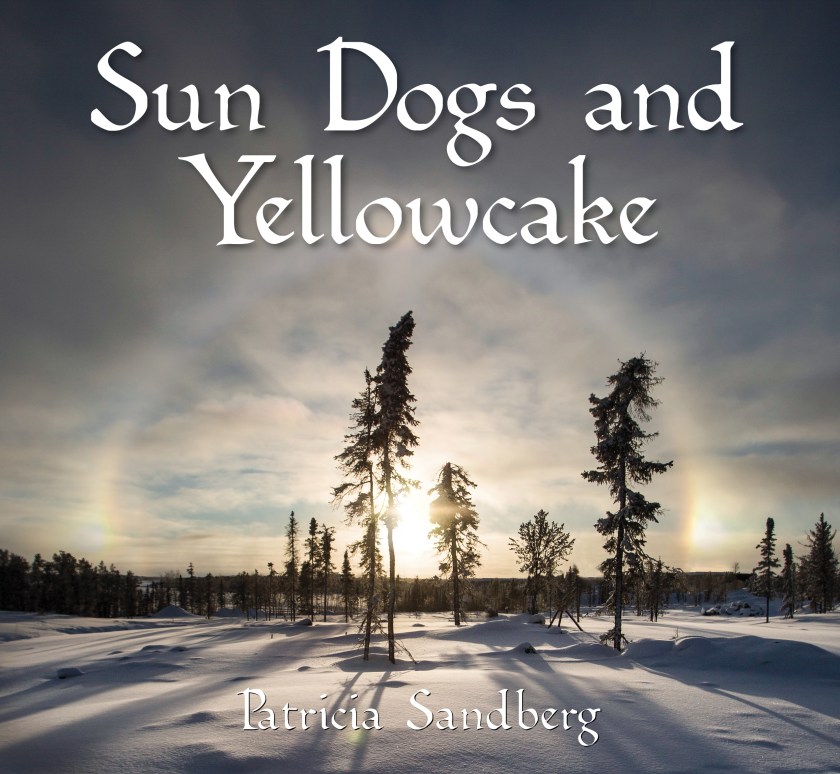
So who knew, certainly not I, just how long and how much work it takes to write and publish a book! But things are shaping up for the publication of Sun Dogs and Yellowcake in early September. My very detail-oriented editor Naomi Pauls has put me through a rigorous review, giving me a new-found and hard-earned respect for the editorial role. The uber-talented Bill Glasgow is shaping the physical design of the book and Neil Klassen has lent his fine creative eye to produce three fabulous maps. And of course, the perfect cover photo is courtesy of artist and photographer Robbie Craig
Woven into the context of the Cold War and post-World War II immigration, and against a backdrop of pristine Lake Athabasca with its First Nations and Métis communities, life in an isolated uranium mining town unfolds. Stories of love, loss, and adventure, with much joy and laughter.
If you would like to keep informed of news, please consider following this blog.
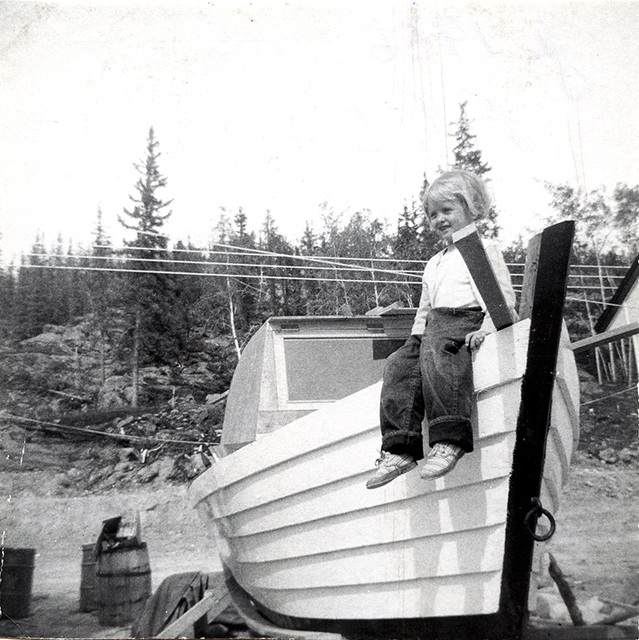
The photo is of me in the early days of Gunnar Mines, Saskatchewan – and in my early days too, of course.
 Gilbert LaBine’s first uranium mine helped end the Second World War. His next fed the Cold War. Immigrants fleeing post-war Europe and job-seeking southerners came to Gunnar Mines in northern Saskatchewan, joining the area’s First Nations and Métis. They found adventure, romance, tragedy, and a freedom never again to be equaled. Meanwhile, lamps made of uranium drill core sat in their homes and their children played at the tailings pond. Sun Dogs and Yellowcake is their story.
The beautiful cover image is based on a photograph by the very talented Robbie Craig.
I am thrilled to announce that Sun Dogs and Yellowcake will be available this September. Stay tuned.
“The most wonderful thing about being Métis is that we come in all colours. My grandmother used to tell me that ‘Métis is how you feel’. I am now part of the culture and have a strong sense of belonging.”

In 1957, one of Canada’s famed Group of Seven painters, A.Y. Jackson, made a surprise visit to the small uranium mining town of Gunnar Mines, on Lake Athabasca in Saskatchewan. He made a few appearances at the local Handicraft club where he gave painting exhibitions and suggestions to the members. Donna Lee was a member of this group and remembers him as being quite blunt, even caustic at times while reviewing paintings. One afternoon, when the club’s members were invited to accompany him on a painting excursion on the rocks, Jackson motioned to her to sit beside him. While they painted, he gave her little tips, such as “use a bigger brush” and “put these little strokes through the water.”
This was a key event in Donna Lee’s artistic career. She would likely have become an artist in any event, following in the footsteps of her talented mother Mae, but Jackson’s encouragement sparked a greater confidence. She sold her first paintings to residents of Gunnar and her career has now spanned more than fifty years.
Donna Lee is a Saskatoon-based artist and she derives much of her inspiration from her experiences of northern landscapes, in Manitoba, the Lake Athabasca region, the Yukon, and northern Ontario. It is, however, the rich heritage and culture that she learned as a child from her Métis grandmother and father which form the foundation of Donna Lee’s work, not only as an artist but also as a teacher and author.
Once Donna Lee’s children were older, she went to university where she obtained a Bachelor of Fine Arts and Bachelor of Education. An early teaching position was in La Loche, Saskatchewan, which has been in the news recently because of a tragic incident. Although much of the current news from La Loche is negative, Donna Lee’s memories are of the many good things that happened while she lived and taught in the community. There she met Suzanne, a Dene woman who became a lifelong friend. Suzanne gave her many beaded pieces done in the Dene tradition, which set Donna Lee on a path of doing her own beadwork. She also learned enough Dene to be able to talk to the elders.
For three or four years, she taught art in the school then switched to working with high-risk students, many of whom were Métis. She related well to the kids and her work with them brought her great joy. “I had a very good relationship with them and they were good for me. So many have gone on to university. I feel so proud of them and am still in touch with many,” she says. “They cared about me because I absolutely cared about them.” In 2003, Donna Lee was acclaimed as an Educator of Distinction by the Saskatoon Preschool Foundation for her work in education.
The time in La Loche brought Donna Lee closer to her roots. Donna Lee says, “The most wonderful thing about being Métis is that we come in all colours. My grandmother used to tell me that ‘Métis is how you feel’. I am now part of the culture and have a strong sense of belonging.”


Her beading enabled her to participate in “Walking with My Sisters,” a renowned art project organized by artist Christi Belcourt to commemorate the Missing and Murdered Indigenous Women in Canada and the United States. Men and women from all over North America answered Ms Belcourt’s call to create moccasin tops (called vamps). Each pair of vamps represents the unfinished moccasins that will never be worn by a missing and murdered woman.
Donna Lee contributed a pair of vamps in honour of a friend, Dahlene Bosse, a member of the Onion Lake Reserve, who was going to go to university. They met when Dahlene became engaged to Donna Lee’s ex-students. The couple married and had a child. One day Dahlene left to go out with friends and never came home. The commemorative exhibit is touring North America and is booked until 2019.
Stay tuned for a second article about Donna Lee’s painting and writing.
I sat up in bed, grabbed a pen and paper off the table and began to write:
It was all vaguely the same and yet different. A glorious sunny day that felt like spring because there was a warmth to the air and the only snow huddled in crevices on the ground.
I walked past the mine buildings that were jumbled together like some crazy puzzle, but still standing. It seemed that people still might be living there because the town didn’t look deserted. I went downhill, then along the road uphill again to the community centre. There was a convention of sorts going on in the community centre and hundreds of people were sitting in the big hall listening. At the end of the session, people were exiting into the main part of the building and I was trying to stop them, trying to find someone who knew anything about Gunnar.
I kept saying to people, “I used to live in Gunnar.” Finally one woman stopped and I tried to write down my email address for her on a piece of paper but the ink was running out. The words kept changing their size and wouldn’t fit in the space. The ones that were on the page were illegible.
I moved on to a man who was there with his family and I asked what brought him to Gunnar. He said that he and his brother were looking to buy the mill and maybe move it somewhere else. He started walking away and I turned in the other direction. Then I thought, “Oh great, I didn’t get his business card with his contact information,” and I turned back but couldn’t see him or his wife and kids. I went running down one of the hallways (there were many more in the dream than in reality) but one corner was very recognizable because I skidded around it on the slippery floor.
After much searching I gave up and went outside. I walked to where there was a small bay. There were many people around. A flying craft buzzed overhead and came to an abrupt landing mere feet in front of me. It didn’t taxi in, just dropped down. It looked more like some fantastic mechanical flying insect than a plane. All its paint was gone and its fuselage was a dull brown as if covered with dry mud.
The pilot jumped down. It was a woman dressed head to toe in a flying suit of the same dull brown colour. She was wearing one of those old war-time airman’s hats with its brim low over her forehead and the flaps pulled down over her ears.
I said to her, trying to make conversation and also because I was curious, “What kind of a plane is that?”
She looked briefly, scornfully, at me and said, “Does that look like any kind of a plane to you?” Then she turned her back to me, pulled a flask out of her hip pocket, took a swig and offered it to someone who she obviously knew and who had been standing behind her.
…
Aside from being fodder for a bored psychoanalyst, this is when you know that maybe you have been working too hard on your project. Or, just perhaps, Gunnar does live on.
As a new year dawns, the past is overtaking me. 2015 has been dedicated to shaking loose the collective memories of former residents of a small uranium mining town on Lake Athabasca. To collecting a wealth of photographs of life in the 1950s and ’60s in the town. To extensive research on how the town, Gunnar Mines, Saskatchewan, came to be and how it ended.
Now, as 2016 comes to life, so too does Gunnar. 2016 will be the year that my book on Gunnar is published.
Writing the book has been a journey back in time to my youth, a simple and idyllic life in the North. It has been a way to ‘resurrect’ my home town that closed a short ten years after it started and to reconnect with people after more than fifty years. It has also been a sad reckoning as Gunnar’s Cold War legacy for future generations hits the headlines.
In the spirit of the season, I post a photo taken in our kitchen at Gunnar in 1959 where my mother Barb Sandberg is making the gravy while her good friend Marge Braund works at the other counter. Friendship.
Stay tuned…

 Pen to Paper